Activity log
The Activity log and Back-office activity log reports are auditing tools that record all actions performed in the app and in your business’s back-office. They allow you to monitor system usage, identify operational issues and keep a detailed history of each operation.
1. ACTIVITY LOG (APP)
Go to the back-office → Reports → Activity log.
Once there, select the required date range. The following optional filters help you narrow your search:
| Filter | Description |
|---|---|
| Date | Filter by an exact time range |
| Device | Select one or more devices |
| Employee | Filter by a specific employee |
| Type | Log type: information, warning, error, etc. |
| Model | Enter a data model: user, tenant_user, etc. |
| ID | ID of an order, shift, invoice, etc. |
| Action | Search by keyword: offline, network, invoice, etc. |
Each log entry shows: date and time, device, employee, type and a description of the action.
2. BACK-OFFICE ACTIVITY LOG
Go to the back-office → Reports → Back-office activity log.
This log is separate from the app log. It records all actions performed directly in the back-office: configuration changes, product creation or editing, price rate changes, employee management, etc.
The following filters are available:
| Filter | Description |
|---|---|
| Date | Date range of the action |
| User | Back-office user who performed the action |
| Model | Affected entity: MenuItem, Category, TenantUser, TillReport, etc. |
| ID | ID of the modified item |
| Action | Operation type: created, updated, deleted |
Each entry shows:
- Date and time of the action
- User who performed it
- Model and ID of the affected item
- Change description: modified fields, previous and new values
COMMON USE CASES
- Audit who changed a price or product → filter by model
MenuItemand the product ID. - Check whether an employee was created or deleted → filter by model
TenantUser. - Review changes to business settings → filter by model
BusinessorOrderConfig. - Identify accidental deletions → filter by action
deletedwithin the suspected date range.
3. APP LOG DETAILS
Below you will find the meaning of each entry that may appear in the Activity log (app). The symbol %@ represents a dynamic value that changes depending on the context (product name, ID, amount, etc.).
ORDER MANAGEMENT
| Log entry | Meaning |
|---|---|
Added (%@) | Product added to the order |
Add default item: (%@) %@ | Default product added automatically |
Quantity updated for %@ from %@ to %@ | Product quantity changed |
Removed item: %@ (%@) with quantity: %@ | Product removed from the order |
Order emptied | The order has no products left |
Cancel order | The order has been cancelled |
Set free | Order discarded because it has no products |
Toggle splited items | Products split within the order |
Merge with %@ | Order merged with another |
Move content %@ to new table %@ | Contents moved to an empty table |
Move content %@ to table %@ | Contents moved to an open table |
Move to virtual %@ | Table moved to a virtual table |
DISCOUNTS
| Log entry | Meaning |
|---|---|
Added discount (%@) | Discount added to the order |
Applied general discount to each content | General discount applied to the whole order |
Discount removed | Discount removed from the order |
SAVING AND SYNCHRONISATION
| Log entry | Meaning |
|---|---|
Save | Order saved locally |
Saved state - context, analytics, offline orders, userDefaults | Internal activity log saved by Revo XEF when the app is moved to the background. |
Retry to save | Order save retried |
Save failed! %@ | Error saving the order |
No need to save to server, order has't been changed | The order has not changed and does not require synchronisation |
Trying to save when still saving... | Save attempted while another save was in progress |
Close without saving yet | Order closed without saving |
Updated status | Server data updated |
LOCKING AND ACCESS
| Log entry | Meaning |
|---|---|
Lock | Order locked |
Unlock | Order unlocked |
Force unlock | Forced unlock of a table with an existing order |
Check if locked | Lock status checked |
Can't lock because is locked by: %@ | Unable to save: order locked by another user |
Try to print when locked by another | Print attempted while the order was locked by another user |
INVOICING AND PAYMENT
| Log entry | Meaning |
|---|---|
Invoice created | Invoice created |
Failed to get new invoice id | Error obtaining a new invoice ID |
Delete invoice with id:%@ | Invoice deleted |
Delete payment with id:%@ | Payment deleted |
Reopen and delete invoices | Order reopened and invoices deleted |
Reopened | Order reopened |
Charged with (payment method) | Payment taken using the specified method |
Changed payment method | Payment method changed |
Fast Cash | Quick payment completed |
Charge with mPOS | Payment started with mPOS |
Send invoice by mail | Invoice successfully sent by email |
PRINTING
| Log entry | Meaning |
|---|---|
Print | Order sent for printing |
Print check from preview | Receipt printed from the preview screen |
Print copy | Copy printed |
Fast print check | Quick receipt printing |
Reprinted invoice from tables layout | Invoice reprinted from the table layout |
Print kitchen note: %@ | Note sent to the kitchen |
Kitchen note printed: %@ to %@ | Error printing a kitchen note |
Print to kitchen failed | Kitchen printing error |
Print to kitchen dish orders: [X] | Products printed to the kitchen by course |
Print to kitchen dish orders: [] | All courses printed |
Print to kitchen dish orders: [0] | First course printed |
Print to kitchen dish orders: [1] | Second course printed |
Print to kitchen dish orders: [2] | Third course printed |
Printed to kitchen from ip X.X.X.X | Kitchen printing from the specified IP |
TABLE AND SESSION
| Log entry | Meaning |
|---|---|
Loaded table: %@ with %@ items | Table loaded with the specified number of products |
Changed table name to %@ | Table name changed |
Preview | Preview screen opened |
Close | Order closed |
Open cash drawer | Cash drawer opened |
Login (S) - Date - IP - Version | Login with the date, IP and app version |
Logout (S) | Session ended |
Exit kiosk mode | Kiosk mode session ended |
No Network, went offline | No connection — offline mode activated |
Went online | Connection restored |
ORDER RECOVERY
| Log entry | Meaning |
|---|---|
Order recovered | Order successfully recovered |
Order NOT recovered | The order could not be recovered |
CASH MACHINE
| Log entry | Meaning |
|---|---|
Cash machine charge completed: %.2f | Cash loading completed for the specified amount |
Cash machine charge failed: %@ | Cash loading failed |
Cash machine canceled | Process cancelled on the cash machine |
4. PRACTICAL EXAMPLE
The following example shows the full sequence for a table, from opening it to taking payment:
Read this part of the log alongside the sequence described below.
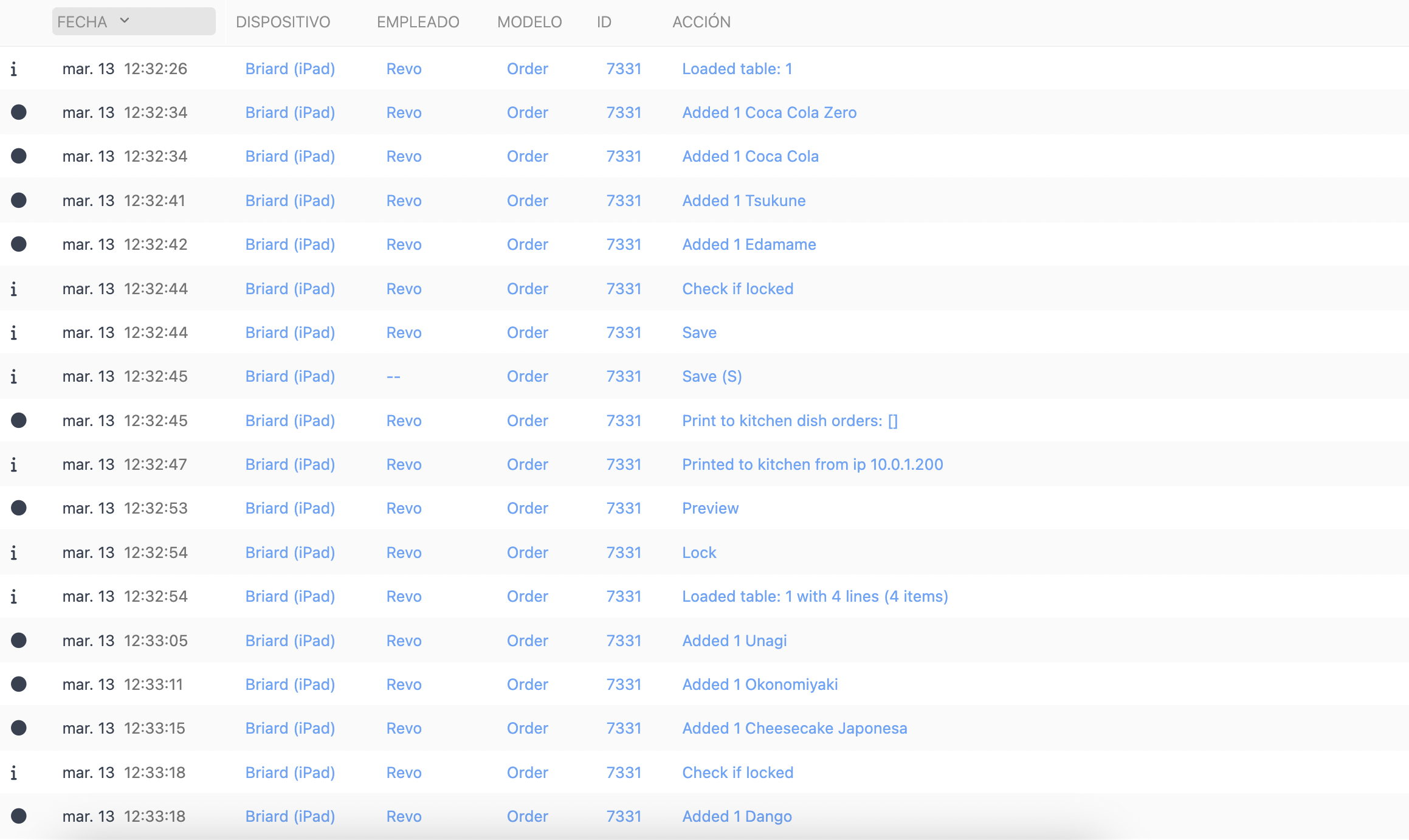
Read this part of the log alongside the sequence described below.
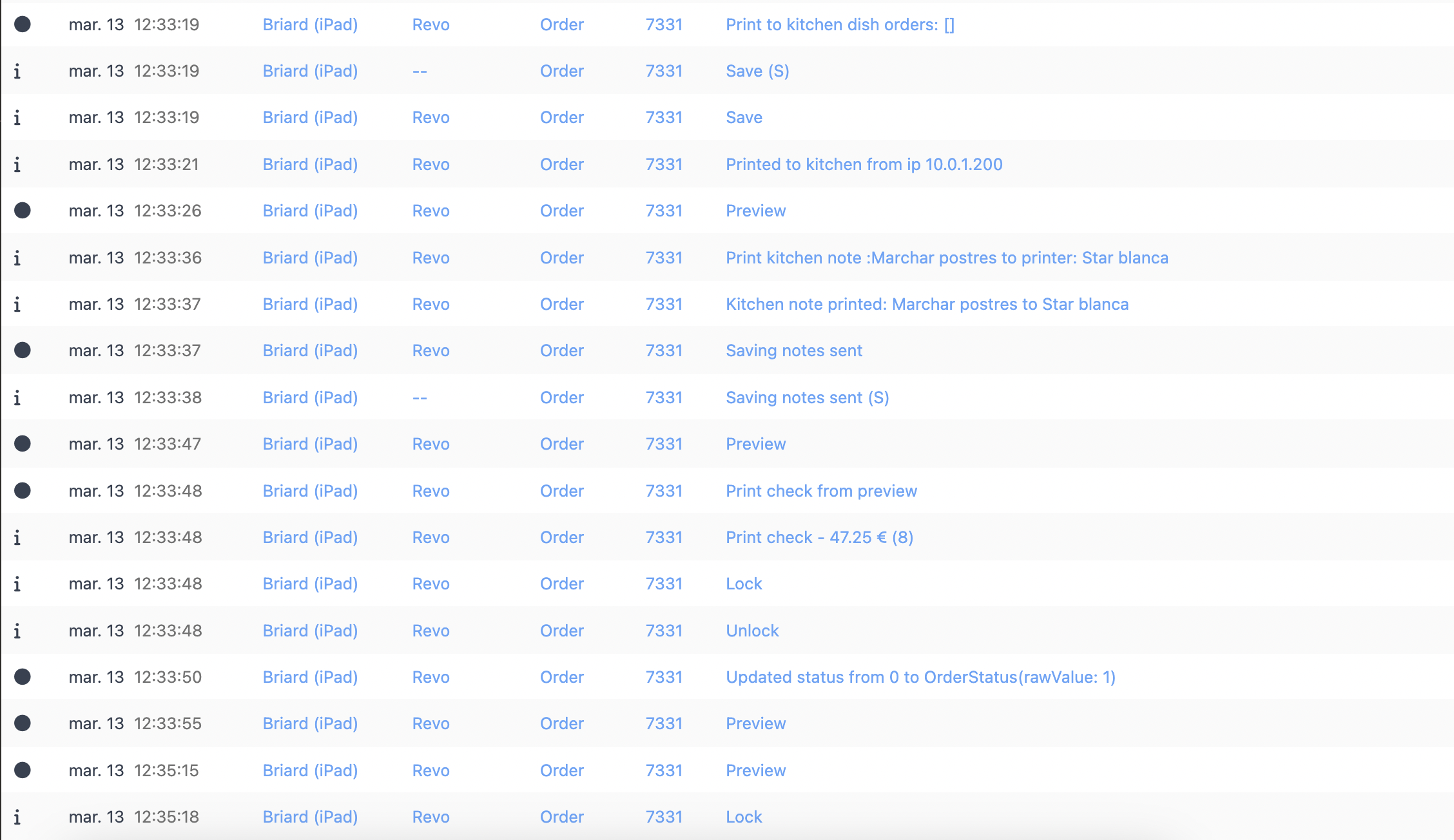
Read this part of the log alongside the sequence described below.

- Table 1 is opened.
- Products are added: Coca Cola Zero, Coca Cola, Tsukune, Edamame.
- The order is checked for locking.
- The order is saved and synchronised with the server.
- All courses are printed to the kitchen (IP 10.0.1.200).
- The preview is opened. More products are added: Unagi, Okonomiyaki, Cheesecake Japonesa, Dango.
- The products are printed to the kitchen again and the order is saved.
- A note is sent to the kitchen: Send desserts to the white Star printer.
- The bill is printed from the preview (47,25 € — 8 products).
- The order is locked and unlocked to reflect that the bill has been printed.
- Payment by Card is started and completed (47,25 €, change 0,00 €, tip 0,00 €).
- The order is closed and saved, and the invoice is created.